-
Right Activity for the Right Day
Have you ever showed up to the barn to work with a horse, brought them out of the pasture, and quickly realized that they were having a bad day? Maybe they walked away from you when you went to halter them, when they normally halter just fine. Maybe they were sticky and hesitant to move, or spooky and high-headed just walking to the barn.
It’s never fun to have something in mind for the day’s activities and then realize that your horse would rather be decompressing in front of their hay. I used to either try to press my agenda anyway, leading to frustration and disconnect, or not do anything at all. Now, unless the horse is having a meltdown, I try to take them out and modify the activity for the kind of day that the horse is having. Maybe we go to a familiar place to work, instead of exploring somewhere new. Maybe we do things for much shorter intervals, only three minutes where it would have been ten. Maybe we just hand graze right outside the gate. The horse gets an experience that’s still within their ability to cope, and I get to demonstrate that I’m able to see their stress and accommodate it. They’re able to have an experience where we go out when they’re not feeling their best and it’s not so difficult. I hope that over time this builds more trust between me and the horse. What do you do on days when your horse isn’t feeling their best?
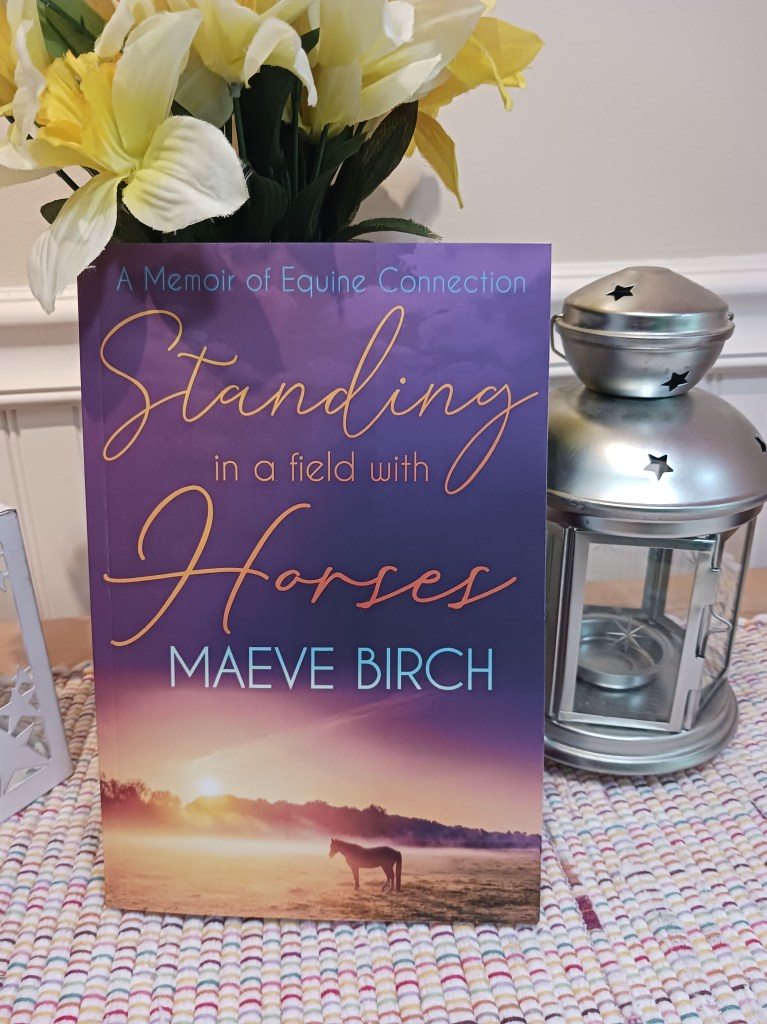
Remimder that Standing in a Field With Horses is going to be out as an audiobook on Audible and Spotify in the next few weeks! If you’d like to read it in eBook or physical page-turning form, it’s available on Smashwords, Amazon, and other book retailers.
-
What do horses dream of?
If a horse had goals for themselves, what do you think they would be? Would they aspire to being the greatest at jumping with a human on their back? Winner of the most money? Fastest on a dirt track? Or would they have dreams of their own? What matters most to them? What does a horse dream of, and can their dreams ever be made known to the humans who care for them?
These are the questions bubbling up in the public consciousness surrounding horses on display. What is it that the horses want? What do we really want to do with horses? Deep down, what are our collective dreams, across species? Are they ever compatible?
My audiobook for Standing in a Field With Horses gets the finishing touches this week, and soon will be released on Audible and Spotify. The book format is available on Amazon and through other online book retailers. Stay tuned for upcoming podcast interviews!
-
Equestrian Olympians and Wandering in the Wilderness
Four years ago I was watching video of a horse being punched on live television in the Tokyo Olympics. The result of that incident was the removal of horses from the Pentathalon event, a cascade of people searching for more ethical ways of working with horses, and a chapter in my book. This year a new round of scandal surrounding equestrian Olympians has occurred, and the Olympics haven’t even started yet. More people will be looking for a way out of the competitive horse world. People who have hit horses with whips many times, because they were told from the time they were children that if they loved their horse then this was what it took to keep them safe. Those people, if they are looking for a place to land, will be wandering the wilderness in the same way I was in the time period that my memoir was written about (albeit some with much more horse experience). They will be hacking a new trail for themselves when the obvious, wide, “safe,” paved path of hitting a horse when they’re not doing what the human wants is right next to them. What I ask is that we extend a hand if someone is wandering and say “I, too, have hit a horse because I was told that was my only option. I, too, don’t wish to go there anymore.” The beacons of more emotionally aware, ethically sound horsemanship are out here. I hope that more equestrians can find them. It’s really hard to feel alone.
-Maeve Birch, author of Standing in a Field With Horses
-
Stress-free Equine Event Planning? Breaking it Down
It’s the day after Independence Day in the US, and a lot of us were sitting with our anxious animals while fireworks went off around our homes and barns. I used to enjoy fireworks a lot more when I didn’t have any worries about a horse running through a fence or stall guard in panic at the loud noises and bright flashes. Thankfully a lot of the horses at the barns I go to are decently ok around loud noises, or at least ok enough not to run through solid objects.
As with most stressful activities, the day of the event is not the day to start planning. Whether it’s fireworks, trailer loading, or vet visits, there are some activities which we know will occur at some point in the horse’s time with us. These are the things we can help the horse to understand well before the actual event. Even if we can’t mimic it exactly, there will be small details that we can get the horse more comfortable with. The more details we can include, the less is brand new on the day of.
For example, if your horse needs a vet visit to treat a wound, does your horse know the steps to a sedative or local anesthetic injection? Have they seen a human with medical gloves on before? Have they ever smelled isopropyl, iodine, or other wound wash? Have they heard the crinkle of sterile wrappers being opened next to them? How are they with someone feeling around for a vein on their neck, or putting a bandage on them? All of these things are fairly easy to replicate with little cost. Even an injection can be mimicked with a ballpoint pen with a cap on it. Short of inserting the needle into their neck, every step in the process of sedating can be replicated for the horse, introduced slowly and one at a time with lots of positive experiences built in. These same individual pieces of an experience exist for things like trailer loading, loud noises, shoeing, or any other activity which would be stressful if introduced all at once.
Try this activity: get a piece of paper and at the top write a stressful event that you know your horse will have to go through at some point. Then, below it, write down as many things as you can think of that your horse would see while that activity is happening. Then list everything they would hear. Then smell, touch, and taste. Once you have written down all five senses worth of input, next to each write down something you could do to introduce just that one item to your horse. Then, pick one or two to introduce to your horse this week to see what they think about it. If they get nervous, that is something to work on with them prior to the next time you need to do that stressful activity. Maybe next year the fireworks won’t be so bad, if they’ve started from hearing it played on your phone at one tenth the volume and gradually worked up to it. There’s a whole year to prepare! Best wishes for less stressful events in the future.
-
Increasing Understanding
I keep forgetting to update words in the midst of all the things happening in real life. The issue is, the things in real life are still too “everyday grind” to spark any great words. I don’t have any inspiration for you today, but I do have a small moment in time that I found interesting and satisfying in my time with the horses.
I’ve been trying to find ways to convey to one of the horses that they need to move their back end closer to the mounting block if I am to get on. He doesn’t seem to have a problem with me getting on, exactly, he just gets very interested in what I’m doing and wants to turn slightly so that he can interact with me with his face. His back end drifts away in the process. Then when he gets done investigating what I’m doing on the mounting block, he faces forward but his rear is still two steps away from where I need it to be. I’d like to move just the back end closer.
So I tried something I saw while researching ground exercises for classical dressage. The dressage whip reaches over the back to tap high on the horse’s opposite hip. This moves the hip towards the human. I was in the stable while trying this, and the horse was calmly moving over when I tapped the hip closest to me, or even just pointed at his hip. On one side he was able to figure out what I was asking when I tapped the hip on the opposite side from me. He stepped over towards me with his back foot.
“Good, good! Yes.” I praised, and gave him his favorite neck scratches. The other side was where he had trouble understanding. I tapped that hip from over his back and he moved forward. I stopped tapping because well, it was movement. That was a good start. But I continued once he stood again. He tried forwards, then when that wasn’t working he tried backing up. I kept tapping, but he started going forwards again, then got frustrated, tossing his head against the lead rope pressure and pulling away from me.
“I don’t get it! What do you want?” He insisted. I stopped and thought about it. How could I make what I was asking for easier to find? I looked around the stable. There was a low wall separating the lounging area from the wash stall, which formed a nice corner without being too claustrophobic. I walked him over to it, then asked him to move his back feet over from the same side that I was on, to sort of give him a precident of moving in that direction. I circled him, then brought him back into the corner, positioning myself on the opposite side of him this time. With the low wall in front of him and a board to his left, his choices were naturally narrowed to back or towards me. I would only have to put pressure on the lead rope to discourage backwards movement. I began the clear but gentle tapping on his opposite hip. After trying back again, he took a tentative small step towards me with his back hoof.
“Very good! Good. Yes.” I stopped tapping and started scratching his neck. He licked his lips, relieved to have figured it out. He’s a horse that has little patience for getting the wrong answer repeatedly, even without escalating pressure from my side of things. I’m glad I was able to use the environment to make it easier for him. I still don’t know why it came to him instantly on one side but not the other. It’ll be interesting to see if other things are harder on that side in the future, or if maybe he had a difficult experience with stepping towards a human on that side or something. I love puzzling through these little connundrums with each horse.
For more on my explorations with horses, check out “Standing in a Field With Horses” on Amazon and Smashwords. Coming soon to Audible and other audiobook providers!
-
Big News!
Fantastic news! I am excited to announce that Standing in a Field With Horses is becoming an audiobook! Now you will be able to listen to the book while you drive, do chores, or even fall asleep to it. Audiobooks allow the freedom to listen on the go, which I didn’t fully appreciate until I began driving longer distances to the barn.
I’m lucky enough to have the terrific team at SkyDance Mountain Audiobooks producing it. They are a company that focuses on audiobooks for independent authors and publishers. Having a small business such as this one doing the production means I feel well taken care of. The samples I’ve heard so far sound great, and I can’t wait to share this with you all. I will also be appearing on a podcast interview or two in the near future! The audiobook is arriving on Audible, Spotify, and other audiobook retailers in July. In the meantime, check out some of the existing titles produced and narrated by the SkyDance Mountain team: skydancemountainaudiobooks.com
-
Clouds and Horses
I regularly listen to a podcast called The Emerald. It’s one of my favorite animist/spirituality podcasts, part informative, part future-dreaming, meaning searching, trance-inducing journey through cultures and environments both foreign and familiar to me. This latest one, On Clouds and Cosmic Law, held significance because it relates very intimately to what I’m going through now. Thoughts about responsibility and natural law, the ways in which our influence on the natural world inherently changes its influence on us.
I have had such significant questions about why I’m continuing to try and work with horses when it seems that they always come wrapped in human chaos. I find it impossible to experience “horse” right now without also experiencing all the stress and human politics and money woes that come with “horse.” Ideas about what a horse should be clashes harshly with what a horse is. Ideas about what a horse should do crashes into what a horse is doing. Chaos ensues. I want to give up. I want to throw my hands up and walk away and say I’m done with horses. Not because of the horses, but because of the human world they exist within. Sometimes I can hardly bear it.
And then I listen to an episode of The Emerald that talks about the gathering and dispersing of clouds as a natural law, that a cloud has impermanence but the laws behind the cloud’s existence is what is unchanging. That humans have interacted with the natural world in ways that made sense for far longer than our current world of fighting for any amount of resources and control we can get our hands on. We know, deep down, how to ebb and flow. How not to take and take until everything is gone. And at the end of the episode, after having lulled me into a state of trance with the words of elders who know how to give and take in better relationship, a voice speaking of horses. And that was the first and last time it was uttered in the entire podcast. I think the Horse Spirits laughed at me, sitting there swearing at a podcast. “You know you’re not done.” They laughed. “Get up. Get up. There is more dancing yet.”
More about my experiences with horses can be found in my book, Standing in a Field With Horses, available from Amazon, Smashwords, and other book retailers.
-
The Third Body
My life has been barely controlled chaos for the past few weeks, but it now seems to be giving me enough of a breather that I’m able to form coherent thoughts. Thoughts of things that I’d never considered in horse/human relationships before, because it’d never been so glaring.
Mildly stealing from the title of a new sci-fi film I’m eager to go see, there is a Third Body in our mutual orbits. The horse and human were the ones I concerned myself with for years. Yet horses are heavily influenced by the third entity. The land. Whether through ingesting grasses, finding shelter from the prevailing winds, or traveling across it, horses are in constant contact with this third entity. As humans, sometimes we forget.
I was starkly reminded of this by the land at this newly established boarding location. It was absolutely uncooperative with what we as horse owners and leasers were trying to force upon it. The initial setup, flat grass paddocks at the bottom of a slope, meant clay soil threatened to turn to slippery mush and deep sucking mud with too much horse traffic in too small an area. It’s temporarily solved by keeping the horses in stalls when it rains, but then the horses show the typical behavior problems that crop up with confinement. They become stressed with pent-up energy and boredom. The alternative is an unkempt wetland bordered by hills full of saplings and dense brush, punctuated by small meadows of native grasses. We’re still in the middle of figuring out ways to preserve the wetland while still giving the horses a better environment to thrive in. We’ll see if things work out the way I hope it will. The land has its own opinions on things, just as the horses do. Forcing it might work, if we had enough resources and heavy equipment. However, it would break the land. It would never be the same, and the area would cease to act as a filter and a buffer for the water. Already the entrance to the property, downstream from the marsh, becomes flooded in heavy rains. Damaging the bottomlands would turn it into a deluge. So we stand and breathe. We find the deer path through the dry areas that we wouldn’t have seen without stillness. We test. “What is your response when we do this? What about this?” Operating within the boundaries of what the land can handle is, frankly, odd in our society. Just like allowing horses to disobey is odd. Just like allowing ourselves to feel is odd. To exist mindful of the non-human partners, instead of using them as a backdrop for our own story is something that I’m still continually growing into. It’s a necessary, but sometimes difficult, shift.
For more on the beginnings of my time with horses, check out my memoir, Standing in a Field With Horses. It’s available from Amazon, Smashwords, and several other book vendors.
-
Changing Worry
I walked Rex for the first time in almost two months and found that I had changed. Between an illness, a new project at work picking up, and leasing a horse again, I had not been able to do more than stop to visit with Rex in the pasture for a few minutes every week or so, just to show him that I still existed. For a while I let others entertain him on Saturdays. This is the benefit to not owning a horse, I’ve found out. You can be absent for a while without worrying that they’ll be feral when you return.
I spent some time learning how to let things happen without trying to shape it with worry. For a long time I thought that if I cared about something then I should spend mental energy worrying about it, and somehow that would convey to the universe that it should go how I want. More recently I’ve tried a new strategy. I ask myself “am I going to change my actions and make a change in the situation?” If the answer is yes, then I take that action. If the answer is no… I work on dropping it entirely from my mental space. It’s difficult. Worry has a way of sneaking up and grabbing you, pulling you into a circle, tugging on your thoughts. Wrestling free of it takes effort. Still, something has changed.
I walked with Rex up the neighbor’s driveway, where we hadn’t been before. That neighbor had told the barn owner last week that they could use some of the property, including the driveway, for hand walking the ponies. Rex was excited and a little nervous. As we walked I sometimes had to bring him in a circle around me to use up some of that nervous energy. Before, I would get a sort of tense rushing feel in my chest when Rex was like this. With the practice in releasing worry, though, I found I could identify and release the feeling faster. It no longer built up. In return, Rex grew calmer as we walked on, not more antsy. It was a great experience that I hope will repeat in the future.
I have a potential surprise in the near future for the book! Stay tuned…
To find out more about Rex and the other horses, read Standing in a Field With Horses, a Memoir of Equine Connection. Available from Amazon, SmashWords, and other book distributors. -
Riding the Line
In working with horses I’ve been lucky enough not to run up against time limits very often. Time limits like “we have to get this horse ready for this show,” or “the farrier comes in two weeks and if this horse can’t be trimmed then it’s feet will start degrading before the farrier comes around again.” Many horse trainers are slotted into 30, 60, or 90 day “colt starting” limits that are dictated by how many horses they can train at one time and how much money their clients can reasonably spend on training. Time limits, in our human world, are inevitable.
I am finally faced with a limit, though I am reasonably sure I’ve left enough time for us not to feel the squeeze by the due date. I have a young horse I’m offering to help get ready for a trailer ride to a new home. Like Rex, he hasn’t been on a trailer since he arrived as a yearling. Unlike Rex, he’s large pony/small horse height. Trailer loading, if he takes a fright at the wrong moment, can get dicey. So, I’m riding the line for the first time in a while between “just get it done” and “stay below threshold.”
Thankfully this horse is trusting of people and has a really good foundation in ground handling. It also helps that he’s a pretty steady guy, willing to investigate things instead of running from them immediately. I just have to stay focused on the present and not get anxious about the “what if’s.”
To help with this, I’m using the same tool that I learned from some of my early riding lessons. In those, focusing on an outside objective kept my mind off of all the things that could go wrong. I was fetching a hula hoop from a post to hang on a barrel across the arena for the riding exercise. For this “intro to the trailer” exercise I was fetching a lantern from where I had hung it on the trailer door. The horse getting familiar with approaching and then leaving the open trailer was a “side effect” while I stayed focused on the primary task. It worked to keep me calm, even while feeling waves of nervousness coming from the horse. It kept him below threshold, having someone attached to him who knew exactly where they were headed at all times. Hopefully this can be extended to steps into and out of the trailer, with some pauses for investigating and snorting at the strangeness. Everything is still just experimenting and seeing how it affects the horse. We’ll see how we do with a deadline, riding that edge without going over.
If you’d like to hear more about Rex, early riding experiences and more, it’s all in my memoir, Standing in a Field With Horses. Available on Amazon, Smashwords, and other online bookstores. Now also available from small business stores! If you own a small business and would like to carry my books, please get in touch through my Contact page.
-
Subscribe
Subscribed
Have a WordPress.com account? Log in now.

