-
When “Truths” are a Lie
One of the hardest parts of understanding horse welfare has been the lies and omissions that pervade equestrian activities. Shortly after I took my first riding lesson I went to watch a four star eventing competition. I studied the professional sport riders, hoping to see what “real” riding looked like. However, I was confused by how wound up the horses appeared much of the time. “That’s what a high level horse is like,” I was told, “they’re really hot blooded.” One dressage test involved a horse wringing it’s tail every time it was asked to move into a different gait or switch leads. I asked about it, and was told this is how horses stay balanced and upright while being ridden. By flipping their tails back and forth rapidly. Not every horse did it, though, so it was confusing to me. I wonder if the person who told me that truly believed that, or if it was something they told me just to stop my questioning.
In the subsequent years of handling and observing horses, it became frustrating for me to hear different “truths” about what a horse was expressing or thinking from the horses’ behavior vs from the people surrounding me. A horse bucking and shaking its head after every jump was “excited,” a horse standing stock still without breathing was “calm” in the crossties. They were sensitive but thick skinned in the same breath. Lame in one leg and naughty in misbehaving under saddle. A professed soulmate and proclaimed idiot. It made my head spin. How could a horse be avoiding work by “faking” an asthma attack pre-lesson, yet also not have the foresight to know that knocking over their water bucket meant being thirsty all night? How could it be both? Yet somehow it made perfect logical sense to the more experienced horse trainers and owners. I was the one who didn’t know how horses worked.
The truth is we need people from outside of the equestrian world in order to change the equestrian world. There are some things that do require knowledge of horses to understand the nuances, but many times the anecdotal “truths” about horses break down under scrutiny. We need adult beginners to ask WHY and then follow up with “no, that doesn’t make any sense.” When people start as children they absorb whatever they’re told as the truth because it comes from a trusted adult. Adults have a keener nose for bullshit. Adults are fully aware of their ability to say “no, and I’m taking my money elsewhere” if things don’t compute. I think as more folks are attracted to horses as adult amateurs, we may start seeing more rapid change in how horses are treated, both in and out of horse sports.
Maeve Birch is a horse enthusiast trying to find a better way to be with horses. Find the beginning of her explorations with horses in her memoir, Standing in a Field With Horses, available from Amazon, Smashwords, and other online bookstores.
-
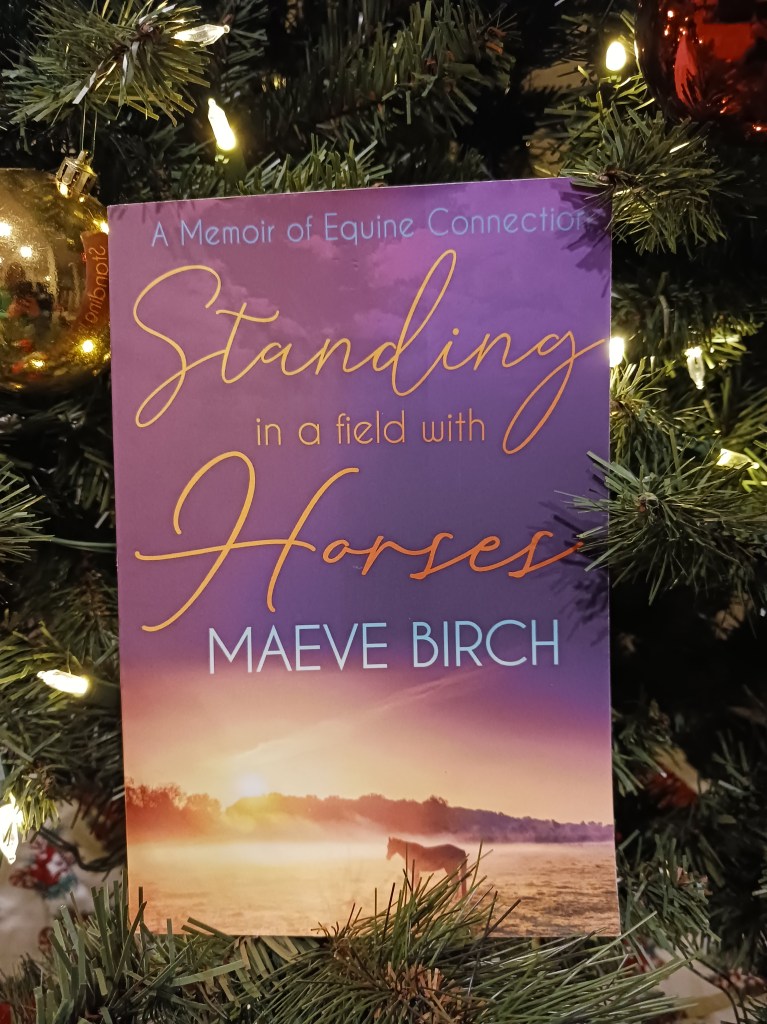
Celebrating a Year of Standing in a Field With Horses
It’s been just past a year since I first released my book in eBook form. Since then more than 200 people have at least purchased my book, if not read it. More folks in the horse world have begun trying to figure out how to change the way they relate to horses. More have simply been introduced to a different point of view, certainly not just by my book but by the slow rolling wave of autonomous horse advocates, gentle horse handlers, and emotionally savvy trainers online and in the media. At the same time, there have been horrors of horse abuse at top-tier barns exposed, more horses dumped into the slaughter pipeline, and the casual disregard of horses’ emotional lives. There is still such a long way to go.
What has become obvious to many is that not only do horses benefit from better horse welfare, humans do too. Unfettered from the clash between emotional awareness and dominance theory, humans are able to follow their intuition into better relationships with horses. Calmer, closer, more trusting relationships. They’re able to recognize that the things that make sense with horses then also make sense when relating to other humans. We are all, at the core, social animals. We, too, only want to feel safe and be treated well in our relationships with others. Horses are just more honest about it.
I hope you’re able to take some slow moments during this holiday season, whether it’s with your horses, with fellow humans, or even just with nature. Find a little pocket of breathing room and let yourself feel whatever you feel just then. I know it has helped me.
You can find my book, Standing in a Field With Horses on Amazon, SmashWords, and other online book retailers. If you’ve read it, leave a review! Thank you so much.
-
New Herds, New Discoveries
It’s been so many weeks since I last posted. I think whatever algorithms drive social media traffic have probably forgotten about me, but oh well. Sometimes things in real life are moving fast and you just don’t have any words that can be shared with a wide audience. That’s fine.
I’ve been getting to know some new horses, since I’ve been presented with an opportunity to interact with another herd. This group is much younger, with one foal being only a weanling. It’s been so interesting learning how the group dynamics change with a baby in the mix. When Rex was a baby he was kept with his mother away from the rest of the herd until he was around a year old and about to be weaned. Most foals are weaned much earlier, at around six months. That’s the case with this foal, who now lives with some other youngsters in the 2-3 year old range, and one older gelding.
I was surprised to learn that babies are treated like, well, babies. The other horses are very gentle with him and he’s allowed to stand anywhere he wants at the hay pile without being driven off. The other horses just eat around him. One gelding in particular has taken up a sort of uncle role and shepherds the little foal around the field. When I first arrived this gelding kept the foal away from me, but as he got to know me better and I hung out in the field more, he’s discovered that I deliver excellent face scratches, and the foal has been sniffing my jacket and nosing my hand while I’m scratching his uncle’s ears. It’s the cutest thing I’ve ever seen, and it takes a goodly amount of self control not to fixate on the adorable youngster. If I do then he scampers off.
There’s always something new to discover when hanging out with horses. I look forward to getting to know this new herd and learning from them this winter.
If you’d like to learn more about my past adventures with horses, read my memoir, Standing in a Field With Horses, available on Amazon, SmashWords, and other online book stores.
-
Dark Season
Well daylight savings time ending has hit me like a truck, as it does every year. Those of us who have full time jobs outside of horses must squeeze in horse time in the cold and dark. The horses are fuzzy and don’t fit any of their tack, the barn cats are instantly in the lap of anyone who sits down for more than a few seconds, hoping for warmer paws. Picking out hooves by headlamp… it’s tempting to just get the barn chores done and go home. The horses would certainly be content with just ’round the clock munching of hay.
Yet, I have a lease horse this winter, and I’m trying to get to know him and form some semblance of relationship in these dark months. I get to the barn after it’s already dark, find the horse by flashlight and pray that none of the other horses interfere as we exit the field. I brush him, pick his feet. We hand graze in the small lit area of the yard, or I go to the outdoor ring to drag poles across the dimly lit sand to make pole mazes and trot patterns for us to navigate together. I’m not sure either of us are fully motivated to do much, but we are at least learning each other’s body language and personal preferences for interacting. Maybe by the end of February we’ll know each other well enough that we can begin doing more outside of the arena, when the trails will be navigatable by the setting sun. In the meantime, simple meetings in the cold dark of the year.
Find more horsey adventures in my first book, Standing in a Field With Horses, available on Amazon and Smashwords.
-
Fall is Book Reading Season!
It’s November, and we’ve had chilly weather here on the east coast for the past few days. Soup weather. Cozy blanket weather. Book weather. It’s also time for me to begin thinking about holiday gifts for friends and family. It sneaks up on me every year, and by December I’m always so busy.
If you’re looking for a wonderful holiday gift, or even a good book to read on these cold dark evenings, check out Standing in a Field With Horses: A Memoir of Equine Connection. When you’re done reading, don’t forget to leave an Amazon review! Only 7 more reviews to go until we reach 20 and I have another prize drawing. 😊 Help us reach the goal!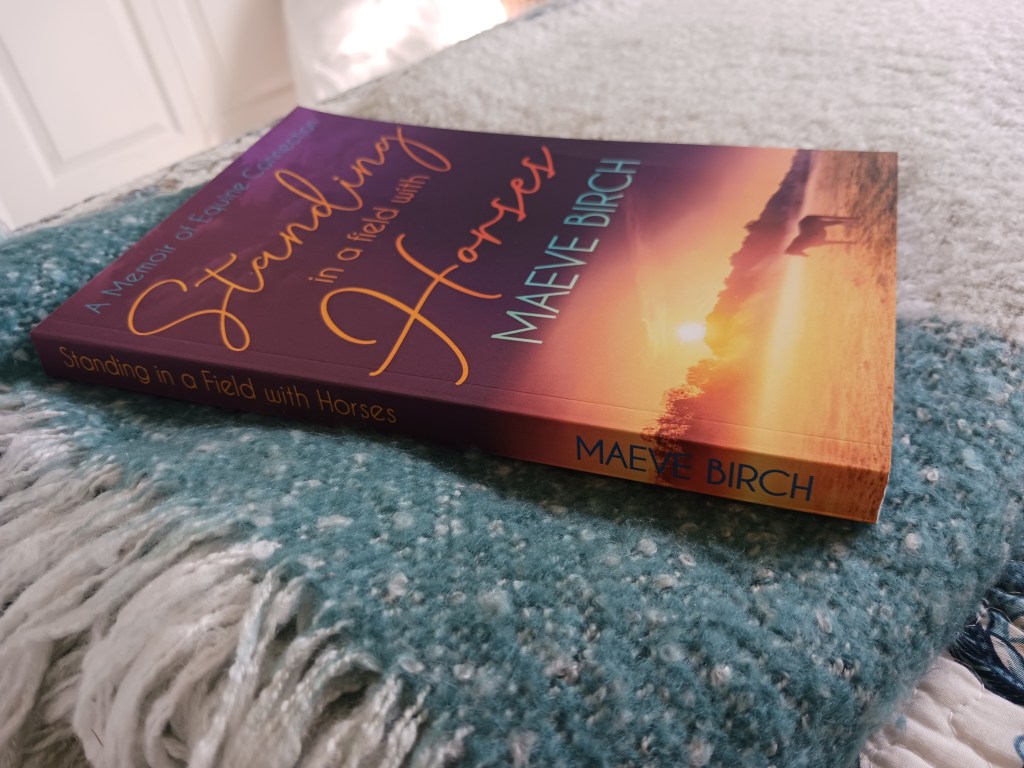
-
Ponderings on Fear
Thoughts for a rainy day. I have several pictures of the Welsh pony I’ve been working with where he’s either nervous or afraid. In one instance, he stood on cross ties in the grooming stall and someone had just started brushing his tail. For whatever reason, this caused sudden fear. His eyes widened, tail clamped, his head went up, and he held his breath. The person stopped, allowed the pony to calm himself, then began again after he had released his tension. Brushing on cross ties was doing something to the horse that he didn’t choose and had no control over.
In another picture I was standing in the same grooming stall with the pony on a long lead rope, and was using finger pressure to push his head and chest away from me to request more personal space. This was uncomfortable for him, and made him a bit nervous. His movements became faster and more jerky, and he had a good deal of facial tension. My physical pressure on his head and chest was an escalation from making shooing motions with my hands and puffing out my energy bubble. Insisting on personal space was doing something to the horse that he had control over. (The pony stepped away, I stopped touching.)
In a third picture the pony was standing in the field with his herdmates while I held an unfamiliar object out through the fence. He decided to come up and sniff it, but was on alert and ready to run if it moved at all. This is something the horse chose to do himself that I had no control over. (There’s no way for me to make the pony interact with the object in this case.)
When, if ever, is fear beneficial vs detrimental to horse welfare? I am still finding the answer to that question, though I suspect it’s complex and dependent on situation and personality. It’s obvious to me what I DO consider a problem. Ignoring the initial fear signals and continuing to escalate pressure is something I’m strongly against. However, if a loose horse investigates something of their own volition… is afraid, but still investigates it, the horse is choosing stress in hopes of learning something new. I would say that fear expression is beneficial. In between is where things seem complex. How much is too much for that individual? What is beneficial expansion of ability or awareness, and what is needless? I think if we’re recognizing and acknowledging fear and asking these questions then we’re maybe at least headed in the right direction.
For more stories about the horses and my journey with them, check out my book, “Standing in a Field With Horses,” available on Amazon and SmashWords.
-
Horse Book Dreaming
The weather here became decidedly autumnal this weekend. Heavy rains and wind from a tropical storm, and nighttime temperatures that convinced the barn to swap horses from night turnout back to day turnout. It feels like book writing weather.
I have plans for my next book vaguely in an outline, but am a little nervous about this book being decidedly more “woo” than my previous one. It will be covering the internal energetics of working with horses. It may be that it’s really about controlling your body movement, tension, and breathing to convey certain concepts to horses. Signals transmitted at a level below conscious awareness. Still, doesn’t our perception shape our reality? Does it really matter in the end whether you pushed a bubble of energy outward or simply stood straighter, squared your shoulders, and held your breath? If the end result is the same, and I speak of energy bubbles, doesn’t the imagination become an action regardless? Sometimes the imagining is far easier than “put this body part here, expand this part there, lift this.” I’m an engineer by trade. I enjoy making things easier. Our brains prefer making things easier. And so, my next book is on the energetics of working with horses, and perhaps a little bit on how this type of energy work can be put to use in other, less horsey areas of life. We’ll see. As the dark half of the year sends me into indoor dreaming and typing mode, thoughts become actions and the magic of words on paper occurs once again. I’m looking forward to it.
To order my existing book, visit my main page at maevebirch.com. If you’ve already read it, then please leave a review on Amazon! It helps others to find the book. Thank you so much for your support.
-
The Pain of the Stoic Horse
I want to talk honestly about the stoic horses. The ones who seem to be stubborn or lazy, when in reality they are hiding the kind of pain that a more open horse would show by bucking or rearing. Instead the stoic horse shuts their eyes and plants their feet and attempts to ignore everything until they can’t anymore. Until the fear of the whip becomes more acute than the fear of pain. Somehow, somehow these horses will literally work until they collapse. We know this because it happens. Less and less, thankfully, due to increased awareness of pain responses, and better vetting. But it does happen. A stoic horse will keep going until they drop, often without any overt indication that there was much wrong with them. Some flaring of the nostrils, half-closed eyes. It’s almost frightening that they are so good at hiding things, but in the wild it’s what saves them from death. How unfortunate that in the modern world many can’t turn this instinct off, start lying down and moaning sooner than at death’s door.
Yet don’t some humans do this also? Our whip is the fear of failure, of not being able to sustain a roof over our heads, of being seen as “not good enough.” Some humans seem to kick out and scream that they cannot live this way anymore when faced with poor working conditions that threaten their health, while others put their heads down and pull more than their weight until the day their hearts and minds literally give out from stress. I’ve lost classmates and coworkers to burnout. Some were hospitalized with heart failure, some had mental breakdowns they never fully recovered from, some died. In the end it was never worth it. It is never worth the inability to ever try again or live a different way.
What we do to ourselves, we do to horses. They bear the brunt of our human societal problems. If it were truly a matter of life and death then yes, I would say they have no choice. But for the recreational rider it is never life and death. It is fear of embarrassment, or a trainer’s limited timeline, or wanting to compete, or needing a ride to justify the expense. The horse hesitates, the whip comes down.
Someone once told me “well, some days my back really hurts too, and I still have to go to work. So the horse can just suck it up and deal with it.” Yet the answer, in my mind, is that the human shouldn’t be forced to go to work while in pain any more than the horse should have to. It’s the fault of our unfeeling societal norms that makes them work while in excruciating pain. You would never know this person suffers from chronic excruciating pain from looking at her. She puts her head down and works. And yet… I worry it’s taking it’s toll. It isn’t a badge of honor or a testament to your strength to collapse one day. No moreso than it would be for a stoic horse. Please, take care of yourselves. Take care of your horses. Listen to the whispers of bodies approaching their limits. Sometimes there will be no screaming before the collapse. Sometimes it happens in total silence, still obediently walking in circles.
-
Books that Influenced Me
If it hadn’t been for the other horsey memoirs and instructional books out there, I certainly wouldn’t have made it to the relationship I have with horses today. Back when the only thing I did was lessons and trail riding I felt the overwhelming itch to learn everything I could about the link between human and horse. Technical riding books confused me, since I was just starting out. I didn’t know what an “inside” was, much less an inside rein. Instead I was drawn to books about people and horses working together. Many teachers who are inclined to be the memoir-writing sort were also some of the more gentle horse handlers and trainers. This worked to my favor in learning how to be around horses and still hold onto my gentle nature.
Mark Rashid’s books were easy to find and there were several of them. In a large way, his books influenced my decision to make my first book a memoir. I learned through his experiences, not through his instructions. In his books he never told the reader specifically “you must do it this way.” He relayed his successes and failures and let you figure it out from there.
I also discovered Linda Kohanov’s books and was fascinated by the similarities between horse herds and human “herds”: what we call teams. She also suggested a spiritual component to horsemanship, which was something I had stumbled upon in my own work. Her stories of horse ancestors and animal communication intrigued me, though at first I was quite skeptical. Later on I would have my own spiritual experiences with horses. I am no longer quite so “anti-woo.”
Finally, I will mention the memoirs written by Frederic Pignon and Magali Delgato about their horses and about traveling the world, performing. I had sadly missed their Cavalia show when they came to the US a few years prior to my introduction to horse work. I was happy to learn more about what I had only seen in YouTube clips: people working with horses in a liberty context, enjoying and displaying the grandeur of a horse existing in its own right, not just as a mount for a rider. Their mention of Tellington T-Touch in the memoir led me to even more great discoveries about horses, including eventually learning energy work and exploring how that related to horses and their communication with us and each other.
No author lives in a vacuum, so I am happy to recommend these authors as continued reading if you liked my book!
If you have not yet read my memoir, you can find it here. Please also leave a review if you enjoyed the read! It helps others to find the book. Thanks so much.
-
Need vs Gratitude
With autumn approaching here in the northern hemisphere, harvest season right around the corner, I tend to get a bit busy. I grow tomatoes, squash, and greenbeans in my suburban yard. Beans need canned, squash needs discovered before it becomes the size of a bus, tomatoes need picked before the next storm or they’ll split. Between work and gardening and horses, the shortening daylight hours bring an underlying feeling of “hurry.” Get it all in before nightfall, coming sooner each week. A scurrying, buzzing inner tension, a craving for the next hour or day or month to satisfy my needs and wants. Sometimes I don’t even realize it’s there until a horse stops me and goes, “I’m not moving until you turn that off.” Reinforcement of self-awareness at it’s finest.
Another thing that is being reinforced by the horses right now is a need for human gratitude. In my riding attempts (and I call them attempts because some days we move, and some days we don’t,) I have been told that same “need/crave” feeling is something that horses receive far too much of. I got this message both from the horses and from a magnificent coach, Lockie Phillips, who I mentioned briefly in my book. When working on the ground I’ve noticed this show up in horses who will avoid blanketing, for example, if the person has a burning need to get them blanketed. If that need goes away and it becomes something they aren’t committed to, then the horse allows it. I call it detachment from the outcome. Lockie calls it being driven by process, not result. The horses call it gratitude, or acceptance of the smallest gifts. The gift of being around a horse. The gift of being allowed to sit on their back without being tossed off of it. The gift of curiosity instead of terror. The breeze being cool, the flies not being as bad today. Does it truly bother me so much that they don’t move off with a squeeze of my leg? They do know how. What do I resort to when faced with a polite “no thank you?” When do I finally let go of my “need” and my “right now?” These are the questions the horses have been asking me recently.
-
Subscribe
Subscribed
Have a WordPress.com account? Log in now.

