-
100 Books Celebration Drawing Prize
Congrats to Trudy Webb, our winner of the 100 Books Celebration drawing prize! Please email me the email address you’d like your horse-related rune reading sent to. I will get it to you by May 30th.Thank you to all who entered!
I look forward to doing more prize drawings for future book goals. If you would like to help me get to my goal of 20 reviews of my book, please leave a review or star rating on Amazon! Thanks to all who have read and reviewed my book. It means so much and helps others find it.
-
Old Paths
Yesterday I was caught off guard by something I thought I had already worked through. It wasn’t a big thing, I just got unusually angry about a situation that shouldn’t have been a big deal. I had to go back and reevaluate why I was so stressed about it. The anger and fear had snuck up on me. It had looked tangentially similar to scenarios I had been unable to escape from in the past, even with a simple and non-threatening solution to it in the present. Thankfully I was able to find a way around it, allowing me to think about the situation a different way and separate it from the past.
Maybe this sounds familiar, because we all tend to do this, especially when already in a new environment, or tired, stressed, or in pain. Suddenly all that work on a behavior or trauma response gets tossed aside in favor of an old pattern, until we can calm ourselves and come back to our senses.
Horses, too, have this response sometimes, especially if they have had an unusually frightening event happen to them, either one time or repeatedly in their past. As their partners and caretakers, we try to work them through their fear and train them in creating a new behavior and mindset. Though their training for the most part gets them through similar situations in the present, sometimes the former fearful response will pop up unexpectedly. It isn’t that the training isn’t working, it’s just that their brain routed it through the old pattern. Horses also get tired, overwhelmed, or have pain, and the fear response rises to the surface.
Will I ever reach a point where similar-feeling scenarios never tip me into my old way of reacting? I’m not sure. Will I understand better why I’m reacting that way and get back to calm sooner? Probably. I suspect it’s the same with the horses I work with. Maybe they’ll always have a certain tool I have to be careful not to use when they’re having a bad day. Maybe I’ll always have it in the back of my mind that they can spook in a place that reminds them of their past. However, maybe it will be easier and easier for them to recover from it. I hope so.
Don’t forget we have a PRIZE DRAWING going on over on the Celebrating 100 Books post until May 19th! Go to that post, like it, AND post a comment on it to enter the drawing. Best of luck!
-
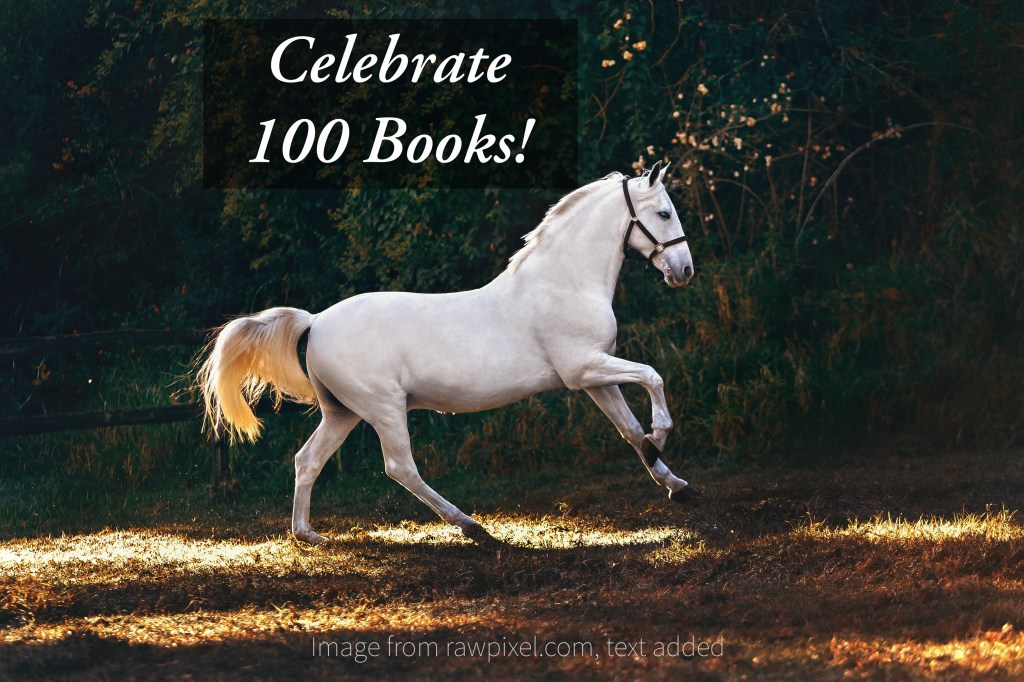
Celebrating 100 Books!
Well, we made it, and only a few days into the month of May! Standing in a Field With Horses has reached a hundred sales! That’s a hundred more people who have read a story about learning relate to horses without dominance. A hundred more joining a beginner in tentatively feeling out some way to stay true to herself while discovering the equestrian world. A hundred reading about an average human communicating with horses in new and unfamiliar ways. Thank you all for being on this journey with me!
To celebrate the first hundred books, I am doing a random drawing for a horsey rune reading. I have been doing rune readings for myself and friends over the past few years, but I am in no way a professional reader. However, I thought this would be a meaningful prize that is easy to deliver to anywhere in the world via email. I would take a picture of the rune spread and write a description of the runes’ answer to your horse-related inquiry. I have sometimes found readings to be helpful in finding a way forward when I feel stuck.
To enter the random drawing, comment below and like this post! You must both comment and like to be entered. I will draw the winner on May 19th and get the winner their rune reading by May 30th! Best of luck!
Standing in a Field With Horses: A Memoir of Equine Connection is available on Amazon and Smashwords. For new blog posts delivered straight to your inbox, sign up for the mailing list on the Maeve Birch website!
A white horse in a field at Belo Horizonte, Brazil -
Nearing a Goal
Exciting news for the book this month: sometime in May we will hit 100 sales of Standing in a Field With Horses!
It’s amazing to me that this independently published book with no initial audience now has almost a hundred readers. Thank you to everyone who has read it, shared it, and reviewed it on Amazon. It’s a memoir, yes, but more than that it’s a record of jumping the gap from traditional horse training into something beyond. Somewhere there is an equestrian who needs to know that they’re not weak or wimpy for not wanting to bully themselves or their horse into doing something neither wants to do. Somewhere there is a beginner who hears the horses speak but doesn’t think it’s possible to listen to them. This book is written for them, because I went through it. It’s also written for the instructor with a sensitive student, or the parent with a horse-obsessed child. Getting the first-person perspective of someone different than yourself is valuable.
I’d like to do some sort of giveaway when I hit a hundred books. What say you all? Would you be interested in a signed copy of the book? An in-depth rune reading of a horsey question you have, sent to your inbox? A small painting of one of the horses mentioned in the book? What is a good drawing prize?
Don’t forget to sign up for blog posts sent weekly straight to your email, located on the main page! Standing in a Field With Horses is available on Amazon Kindle or paperback, and available in eBook form from Smashwords (and Barnes & Noble as well as Kobo, it turns out!) Gift it to someone who needs a different narrative about horse/human relations.
-
Bits and Pieces
I read a book the other day that was recommended to me by a horse group that I follow. It wasn’t something I would have picked up without a recommendation, but I was curious. The book had some things in it I didn’t agree with, but I also found things I hadn’t thought of in that way before, or conclusions that both this author and I had come to separately while working with horses. All in all, I was glad that I read it, even if some parts made me cringe.
Not everything in other’s experience or views is for us. I have seen instances where disagreeing with one part of a certain horse tradition or method leads someone to toss away every part of that training. I myself have been in this mindset at certain points. In some cases the trainers themselves encourage this all-or-nothing approach. They state that if you don’t take all of it then you might as well take none.
To me this is sorely limiting. What if there’s a piece of something in there that I find is a missing puzzle piece in my own experience with horses? What if I’m interested in working with a horse that has only ever been trained in one tradition, and I want to understand that horse’s mindset better, or start a conversation in a way familiar to them? What if I’m just curious?
I don’t know if I’d ever be able to follow one trainer’s method from beginning to end with every horse. It’s probably simpler. It would get the job done in most cases. But working with a horse is a conversation. Each horse is an exploration of a new relationship. If the horse says “absolutely not” or doesn’t even recognize one way of speaking, is it wrong to shift into something else? Why wouldn’t we take bits and pieces of learning from everyone we come across? Just in case it might be useful at some point. That book may have some things I disagree with and would never do, but there are other parts that I would definitely be willing to try. I would be less equipped without having experienced this differing perspective.
My own book might stretch what you already know, or it might have parts you disagree with and have to dig through for something that works for you. That’s ok! Take the bits and pieces you need. If you’d like to give it a read, or get my blog posts in your inbox, follow the links on my page at MaeveBirch.com
-
“He’s Disrespecting You”
I would like to return these phrases, I don’t want them anymore:
Get after him
Show her who’s boss
Don’t let her get away with it
He’s testing you
Give him a little ‘encouragement’
Give her a tap/kick
Be the leader
Don’t let him dominate you
Ask, tell, demand
Make her work
He’s trying to pull one over on you
She’s faking it to get out of work
He doesn’t respect youI don’t mean that horses never need someone to help guide them through a situation, or never need to listen when a human is talking. I mean that the assumption of conflict is too prevalent. The assumption of ill will. What does the anticipation of conflict do to our bodies on a horse? In mine it tenses me, rushes me. When I read “disrespect” or “wanting to dominate me” into a horse’s response it becomes a personal affront. Suddenly it’s about me, not the horse. Either I’m offended by their lack of respect, or I worry that I’m not good enough for it. Both responses spin my brain inward, taking me mentally off balance. Neither benefits the relation with the horse, any more than it would benefit the relation with a human. Why do we teach this with horses, then claim that working with horses in this way will help form better human leaders? Nothing screams insecurity more than a chronically defensive leader. There are plenty of those around, but the best leaders I’ve found are the ones who listen to their team, sincerely consider their input, ask clarifying questions, then make a decision and hold boundaries about it after a conclusion has been reached. What language we use to describe horse/human teamwork matters, especially when claiming to teach leadership through interactions with horses.
You can find my book, Standing in a Field With Horses: A Memoir of Equine Connection, in paperback or Kindle format on Amazon, or alternatively in eBook form on Smashwords. If you would like blog posts sent to your inbox, sign up for the Maeve Birch mailing list on the main page of my website!
-
Excerpt from the Chapter Rex: Cleverness
It’s springtime, which means my little mini horse buddy, Rex, is suffering from spring allergies again. Until I started volunteering at the horse rescue I had no idea that horses could have allergies, but they can! Here’s how we found out that Rex suffered from them:
“One day in spring, a high-pressure front was moving through, and all of the horses were crabby. I tried taking Rex on the trail and he fought with me the whole way, trying to bump into me, suddenly charging ahead, and stopping suddenly to eat grass out of the cracks in the pavement. I decided the trail wasn’t the best idea and took him back to the round pen, thinking maybe he needed to burn off some energy, but that wasn’t it either. I sat to do some deep breathing and meditation in the round pen to see what came up. The quieter I got, the closer Rex grazed, and I asked him if he just wanted to go back to his paddock. He said yes by coming right over to the gate and standing patiently while I clipped his lead back on.
When we returned to his paddock, he started rubbing his sides and back against the fence like he was incredibly itchy! I gave him a nice long scritches session, which he enjoyed, but once I was done, he still went back to the fence to rub some more. I had figured out why he was so irritable. He had developed hives. I told my barn mentor what had happened and she gave him a dose of antihistamine to help him out. I was glad he could tell me what was wrong and that I was attentive enough to notice something wasn’t right in his behavior. Sometimes horses misbehave because they are just antsy or in a bad mood, but sometimes it’s because they’re uncomfortable, in pain, or in this case, miserably itchy.”
Learn more about my adventures with Rex and the lessons I learned in Standing in a Field With Horses, available on Amazon and Smashwords.
-
Is It Necessary?
When I was new to horses, the first thing I tried was riding. It wasn’t that I was particularly drawn to riding, it’s just that seemed to be the only access to horses available to me at the time. I tried out multiple riding stables, but would get a few lessons in and then stop, because it never felt good. I always left sore, exhausted, and sometimes in tears. It felt like I was trying my hardest to make the horse do what the instructor was telling me to do, and though it took all my effort, it was never enough. Today I am grateful to those horses for slowing down when I was told to go faster. For edging forward when I was supposed to make them stop. For standing still while I held back tears and kicked their ribcage with all the strength that I had. (I was in my 20’s and taking Tae Kwon Do at the time. I broke solid wood boards with those legs. That poor horse.) They drove me away from riding and into a place where I could figure out horse/human relationships first, before ever getting on a horse.
The thing I find most puzzling about riding (and in other areas, but riding is where I see it most) is the distortion of what is necessary. As a student I was told to fight with the horse, to tell them that whatever I was asking for was absolutely, beyond a doubt necessary, regardless of if they took objection to it. And yes, there is merit in getting something very clear in your mind and body before asking so it is definitively conveyed in a confident way. This changes for me the moment the horse says “no.” The next question, for me, is always “what makes you say that?” There was no room for that question in lessons. The immediate response to the “no” had to be “yes, or else.”
Is this necessary?
“Of course,” the traditional training says, “because if you allow a horse to have any question in following your cue then their training slowly falls apart.”
To this I ask, “but in this moment, is it necessary?”
If a horse trotting in circles with an unbalanced rider on their back is a matter of life and death, then I would like to get off the horse. That is too much. It should not be that important. There are too many variables in what might be causing the “no,” especially with a new rider. Especially with one the horse has not spent time building a relationship with. Are the cues wrong or vague? Is the rider nervous? Tired? Distracted? Is their body tense, off balance, or uneven? Is the horse sore? Tense? Sleepy? Hungry? How far into the lesson is it? Has the horse been used in multiple lessons today?
My argument is that we gain far more by asking “why” than we gain by saying “or else.” The small backslide in training that happens as a result of not insisting it’s absolutely necessary is far outweighed by the benefits that both horse and rider gain from digging into the relationship a little more. Even better than this is learning where a refusal might happen in the future and breaking things down into smaller “yes” or “maybe” pieces. Not even asking the question you know you’ll get a “no” to. In the end, it’s not necessary to trot in a circle. That isn’t a matter of life and death. What’s necessary is learning the landscape of the horse/human relationship so that the two can work together without injury, short or long term. That is the success.
Learn more about my early days with horses in my book, Standing in a Field With Horses, available in eBook and paperback formats.
-
Subscribe
Subscribed
Have a WordPress.com account? Log in now.

