-
Something is Wrong
There is something wrong with our horses.
I watched a video last week where three starving, unhandled mustang mares were taken to a rescue after being at a holding facility for who knows how long. The three were released into an arena with a tub of hay in the middle. They were cautious of everything, but eased up to the hay tub and began eating. I was shocked. Not by their condition or their cautious approach to the tub, but that they began eating right next to each other, ears touching, without a single scuffle or grimace. They ate together in peace.
From volunteering at a rescue, I’ve seen how most horses who come in starved behave. They fight, they threaten, they steal other horses’ food if they’re strong enough to do so. The behavior lasts long after they’ve gained the weight back and have had years of predictable food sources. Sometimes even horses who we know have never been starved will resource guard aggressively.
Why does this happen to our domestic horses? One answer may be that we don’t give them something that they need to feel safe enough to share with others. Maybe it’s space, maybe it’s access to food, maybe it’s stable herds, maybe it’s enrichment. Maybe it has something to do with being weaned too early, or kept with only other youngsters and their mom for company at a really young age. Maybe it’s genetic. Whatever the issue… something is different about horses raised in captivity that makes the resource guarding worse. Something is keeping them from the deep family bonds that form in a wild herd, suffering or thriving together as a group, not as competitors. It isn’t so different from our own troubles as humans in our modern state of existence. May we see ourselves and our society reflected in our horses, and make changes there too.
I have started a Maeve Birch Instagram account, maevebirchbooks. It will have the same writings as I post here, but may be easier to share with friends on social media. Check it out and invite a friend!
Don’t forget to leave a review on Amazon if you’ve enjoyed my book, Standing in a Field With Horses. This helps others to discover it and learn about new ways of existing with horses. Thank you so much for your reviews so far.
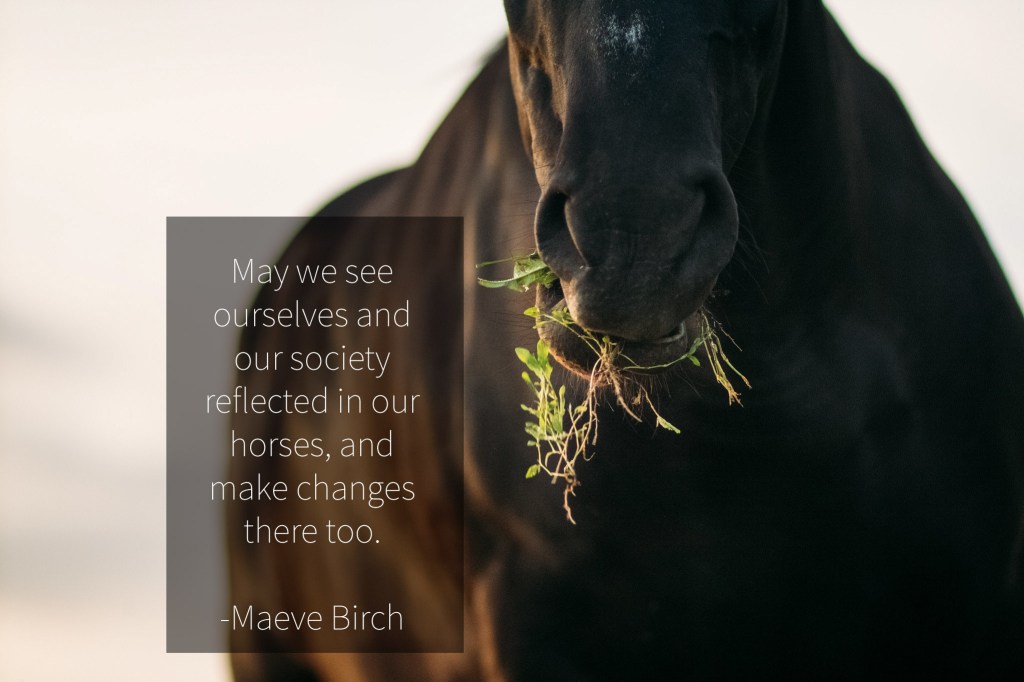
“Horse chewing grass. Close-up photo” by Ivan Radic is licensed under CC BY 2.0. To view a copy of this license, visit https://creativecommons.org/licenses/by/2.0/?ref=openverse. Modification: text box added.
-
Spring Thorns
Spring feels like it’s right around the corner here, even though I know we have at least another month of cold temperatures to get through. This past week was deceptively warm, culminating in a day that had the horses sweating under their winter hair. We had to do a bit of clipping on the undersides of a few ponies, trying to give them some relief while still keeping enough to warm them in the upcoming cold. The horses’ clocks tell them they still need the warmth. Not one has started shedding yet!
My other hobby, gardening, has been getting additional attention lately. I planted some pepper seeds under the indoor grow lights and trimmed up the rose bushes. Rose bushes take time and concentration to prune. Not only do I need to keep in mind the angles and locations of the cuts, I also have to avoid the quarter inch long thorns! Trimming slowly and knowing where my arms are in relation to the plant’s stabby limbs are important parts of the process. It’s amazing, all the places you can practice body awareness. Just like practicing it with horses, you get excellent feedback from a rose bush, though it may be a little more uncomfortable!
For more adventures in body awareness with horses (but not rose bushes), check out Standing in a Field With Horses.
-
Check In, Breathe In, Breathe Out
I teach a course locally on how to recognize the very beginnings of a dangerous situation developing with a horse. Part of it is being aware of your own body, it’s relation to the horse’s body, and recognizing how your emotions and the horse’s are interacting. I had to take my own advice the other day when I was getting on an unknown horse for the first time outside of lessons. He had been giving the owner a little difficulty by swinging out away from the mounting block when she was getting on to ride. He also kept trying to graze at the same time, and I was anticipating having a similar battle with him in order to get on.
I admit that at first I dived right in to the same “pull on his face, try to keep the thousand pound animal from moving” routine I had just witnessed. When I stopped for a moment to check in with myself, though, I realized I was almost shaking with adrenaline!
“Holy moly,” I thought to myself, backing away from the horse, “how did I not realize I was this wound up!?”
The answer was that I was busy doing. Pushing, pushing, pushing to the goal of getting on, because that’s what I was there to do, dammit, was try out this horse for riding. When I paused to take stock of how I was feeling it became obvious that it was a VERY GOOD thing that the horse was keeping me off his back!
The solution was to stand and breathe in, then breathe out. Over and over until the real world came back. By real world, of course, I mean the horse that was standing in front of me, not the one where I was already mentally on and riding. The owner, thankfully, stood and waited. I peeked over the top of her horse and stated that we were going to be boring for a few minutes.
When I brought myself back to reality by standing and breathing, it became easier to convey to the horse that I wanted him to stop trying to graze. Small fingertip twitches replaced the frantic face hauling. The horse began to breathe deeply with me. He sighed. He squared up for me. I was astonished, to be honest. I unfortunately got nervous again when on the mounting block, so we went through even more standing and breathing with me there. Finally I got on, and we stood and breathed there. Then we ambled off at a calm walk, which is what I was told to expect anyway from this beginner-safe horse.
Although I did not end up leasing him, I’m so glad I went out to try. If nothing else, I proved to myself that I could work myself back down from an anxious moment, then still have a calm ride on an unknown horse. The horse perhaps learned that sometimes beginner riders are willing and able to wait until they can explain what they want calmly, instead of riding off in a sorry mental state. When in doubt, check in, breathe in, breathe out.
More horsey adventures are in my book, Standing in a Field With Horses, available as an eBook and paperback. If you enjoyed the book, don’t forget to leave a review to help others find it!
-
Not Alone
The past week has been a little chaotic, as a close family member had emergency surgery and is still in the hospital. It’s the first time in my life when I’ve been so directly involved in helping care for a family member. Thankfully I have mentors I can reach out to who have been through it before. Reaching outside of the situation for help is hard, but going through it alone is even harder. Same as any challenging time, even with horses. Reaching out for help from those who have a similar experience to yours is healing. It steadies you.
I hope that you’ll reach out too when in the middle of a chaotic time, to those who are outside of the storm and willing to assist, even if it’s just to listen. I promise you it helps. Someday you can do the same for someone else.
My paperback book, Standing in a Field With Horses, is available for only $8.99 for a limited time. EBook also still available.
-
It’s Here! Paperback Release
The paperback version of Standing in a Field With Horses is here!
When I was a little girl my aunt and uncle got me a ceramic dragon statue that I was so enamored with, I carried it from room to room with me for a couple of days, just to look at it. Eventually it took up a permanent residence on my bedside table. This paperback has been through much the same treatment. I adore taking it with me just to admire the fact that it’s real, in front of me. But…maybe if you aren’t the author you will simply read it instead of making it into a strange papery pet.
The book is available through Amazon at a reduced price for its release. Don’t miss out! If you read and like the book please leave a review so that more people will find and enjoy the book. Happy reading!
-
Paperback Progress
Hello readers! There has been much progress on the paperback book front. I got my proof copy of Standing in a Field With Horses in, then my laptop started glitching so badly that I had to continue my formatting updates on a computer at the public library. Thank goodness for libraries! I have the second proof copy in and it looks marvelous. The book will be gently released to Amazon on February 2nd, which hopefully puts its availability at that weekend, though it may be longer or shorter based on their review timeline. Oh, I can’t wait to order my author copies!
Behind the scenes I’ve asked one of the folks I look up to as a horse trainer and instructor to review the book. She was gracious enough to do so, and had this to say about it:
“This book is a lucid reflection on the transformative power of horses on the personal development of humans. Birch’s unembellished prose is a departure from the sentimental projections horsey memoirs typically circulate. Instead, this read’s more like one woman’s personal ethnography—a set of field notes—trying to make sense of horse culture, while also making sense of her inner landscape. With an acute self-awareness and determination to attend to core wounds, this author is all of us—confronting emotional patterning to redirect life towards better outcomes. Sifting through science and the felt sense of direct experience to arrive at her own conclusions, she presents an earnest contemplation of how to be in right relation with animal others. An easy, yet deeply insightful read.”
– Shannon Beahen
Founder of Humminghorse Equestrian,
Trauma-informed Trainer and EducatorI am so grateful to Shannon, both for the review and for teaching others about ways of being with horses that are beneficial to the horse AND the human. I have learned so much from her.
Keep an eye out for a post when the book, Standing in a Field With Horses, becomes available in paperback form. It will be temporarily at a reduced price for early sales. You can find the eBook version right now on Kindle and Smashwords. Also, the eBook has become available through Barnes & Noble. Get excited!
-
Self-Aware, Horse-Aware
The equestrian world is intent on the appearance of leadership and strength. Perhaps I should back up a bit and say that it’s true for the entire dominant culture of the United States. Don’t quit, don’t cry, don’t back down… When things get tough, we’re encouraged to beat the odds, fight to win, and make sure we look good doing it.
I don’t know about you, but I don’t look all that great when I’m fighting things. Usually, in fact, I just feel like a hot mess. When it comes to horses, it’s common to take a combative approach to a horse not following directions. Many times in lessons and training I heard the words “make him do it” or “he’s disrespecting you.” It was framed as me vs the horse. I would escalate and escalate, feeling worse and worse, until I was pounding on the horse’s sides with my heels or using full force to smack a horse with a whip to move them, under the shouted commands of an instructor. It didn’t matter, at that point, that I “won” or “lost.” I was already lost, panic overtaking reason and sending me into fight or flight. I was not a leader, I was not displaying strength. I was displaying desperation. It was a mess.
Many times, what I really need is to pause and ask why things are happening. Isn’t that what we would all want from a boss or a parent? For them to ask us what’s going on when we refuse an instruction or act out of turn? Perhaps we received some bad news recently or have something else on our minds. When a horse misbehaves there’s the tendency to become personally offended by it, instead of wondering why, when there had never been a problem before. If I pause, the horse may temporarily learn that they can get relief when coming to a sudden halt or grimacing at the girth. What they also realize, though, is that I’m paying attention. When I’m paying attention, and the horse also knows it, we can work on a solution together instead of being at odds in a power struggle. That, to me, is more valuable than getting my way. That, to me, is making us both stronger. Once we have moved through the problem together, the horse no longer needs to halt or grimace, so the behavior goes away on its own. I hope that many more humans are able to put aside the need to win or to show they’re capable of forcing the horse to do whatever they want, and instead can work side by side with horses to solve problems.
Follow my personal journey into working side by side with horses in my book, Standing in a Field With Horses, available on Kindle and Smashwords. Paperback version coming soon, in February. If you read my book and liked it, please leave a review on Amazon! Thank you so much. -
Coming In Strong for the New Year
I took a two week break from the blog for the holidays. Between family visits, holiday parties, work, and travel, this introvert was exhausted. Isn’t it strange that we take time off only to fill it with activity? Some folks thrive on social activities, but I tend to get more worn down as they pile up on my calendar. January and February are a relief, as I can focus more on the tasks I have picked for myself to be involved in.
One such task is finishing up the design for the paperback version of my book, Standing in a Field With Horses. I look forward to having that ready sometime in February. Keep an eye out for it! I don’t have a set release date, because this is the first time I’ve tried creating a paperback book. I want to make sure it looks as professional as possible for you all.
I’m also working on learning how to stay calm in confrontations with other humans. I know, I know, I’ve been working on that for years, but it’s a cyclical challenge that continues even today. My goal is centeredness in the midst of chaos, and I’m not there yet. Maybe I’ll never get there, but the closer I can be to that calm centeredness the better I’ll be able to weather difficult conversations, no matter the topic. The better I can come back to a calm state after being shaken, the more solid I can be for a horse that may also be experiencing distress. It’s a lot of self-examination and being honest about how worked up I am. A lot of recognizing when I need to pause and come back later or take a step back to breathe. The same skills that are required for working with a horse are useful for bringing anxiety down in ANY confrontational scenario. I look forward to exploring this more in the coming year.
As usual, if you have read my book and enjoyed it, please leave a review on Amazon! It really helps authors by pushing their book higher in the algorithm so more people can discover it. My book can be found on Amazon and Smashwords. Thank you for your support!
-
A Task Without an Outcome
There’s a pony at the barn where I currently volunteer who is afraid of putting her face in a halter. She had been rescued from an abusive situation and is taking a while to warm up to the idea of voluntarily having something approaching her face. To catch her in the field, usually someone has to put the lead rope around her neck and hold that while wrestling the halter up over her nose. It’s far easier just to halter her when she’s in her stall.
I’m trying to teach her how to put a halter on by shoving her nose into it voluntarily and allowing it to be buckled around her face. This involves hay pellets, the halter, and a clicker. In this case I’m using positive reinforcement- a reward for doing an activity that I’d like her to perform. However, it also involves commitment to a task without an outcome. If things are going well, we may progress from looking in the direction of the halter to briefly putting her nose in the halter in one session. However, some days it’s an accomplishment to even look at the halter. If I continued to try to reach a predefined outcome in each session then it’s possible that the pony could reject the interaction entirely, even with the hay pellet reward attached. The entire process could even become aversive if pushed hard enough. Not only would the halter be unappealing, so would someone approaching with a clicker and hay pellets.
Whether hay pellets and a clicker are used, or a gradual approach and retreat with the halter, the attention and stress level of the pony in question always determines the best outcome of the session. We work on the task, but I always try to keep it below the point where the horse decides it’s too much and flees. The task is mine, but the outcome- that belongs to the horse.
Maeve Birch is the author of the memoir, Standing in a Field With Horses, available now as an eBook on Amazon and Smashwords. -
The Feeling of No
What does a no feel like in your body?
For a long time I wasn’t sure what it felt like. I knew intellectually when I didn’t really feel like doing something, but there were a lot of instances when I couldn’t really make a distinction between what I wanted to do and what others wanted me to do. I would ask for excessive outside input for big decisions, make long lists of pros and cons, and fret about whether I would regret my choices, no matter which I chose. I was completely unaware of what my internal no felt like.
After working with horses for a few years I became more aware of what my internal feels process was doing when a horse would get uncomfortable. If I were quiet and attentive enough, I could feel a no forming. Not just a “not right now” or a “maybe if you presented it differently.” The horse was standing still, munching on hay, and still giving me a “No!” They were just on the edge of leaving. If I ignored it and started moving towards them, they quickly left. Identifying that tipping point and how it felt in my body allowed me to gauge whether or not I could catch a horse, touch them, or brush and blanket them in the field. It was very valuable to know the tipping point.
The horses’ “no” helped me get quiet enough to identify my own “no’s.” When I was presented with a decision and got quiet and attentive to my internal environment, I would feel an internal cringing, a tension in the chest, a small desire to run. Discomfort, more than anything. Some people may have louder internal “no’s,” but mine was small and quiet. It took effort to detangle my desires to please other people and find the “no” firmly planted in the center of it, like a burr stuck in the middle of a tangled mane. Invisible, until I looked for it.
Now I look for my “no” fairly often. If something doesn’t feel quite right I start searching. Sure enough, I find that little burr and examine it closely. Sometimes I decide to drop it to the ground, because it isn’t how I want to be at that moment. More often, though, I hold it up and declare that it’s important. My “no” matters to me now, and my life has been a lot better since the horses taught me how to search for it.
A reminder that if you have enjoyed reading my book, Standing in a Field With Horses, please leave a review on Amazon! It helps the book to reach more readers. Thank you so much for your support!
-
Subscribe
Subscribed
Have a WordPress.com account? Log in now.

